Showing posts with label books. Show all posts

Tuesday, November 04, 2008

Book Review: Garfield Minus Garfield by Jim Davis and Dan Walsh

Garfield is one of the most popular comic strips in the world and in its 30-year run has spawned beloved animated specials and series, live-action and animated films, and tons of merchandise. However, the strip takes on a new life when the title character is removed in Garfield Minus Garfield. This collection of strips culled from the popular (and Jim Davis-approved) site garfieldminusgarfield.net is a fun example of addition by subtraction.

Fans (and non-fans) of Garfield have always found ways to tweak the strip. The Garfield Randomizer lets visitors create their own strips out of random panels. Images of strips with Garfield's thought bubbles removed or Garfield replaced by a silent, realistically-drawn cat have been circulating online for years. Dan Walsh, creator of Garfield Minus Garfield, went one step further by removing Garfield from the strip entirely.

Without Garfield's wisecracks, the focus is squarely on Jon, Garfield's perpetually single owner. While it's always been clear that Jon's a bit of a nerd, Garfield Minus Garfield really highlights Jon's lonely, strange, and sometimes sad life. The humor found in these modified strips comes from different places than your typical Garfield comic. Some strips have a dark, existential feel reminiscent of Stephan Pastis's Pearls Before Swine. Some have a randomness to them that let your imagination run wild. Some are hilarious simply because you immediately empathize with Jon's situation. There are also strips that feel more dramatic than funny.

Each page of Garfield Minus Garfield is arranged with the modified strip on top (in color) and the original strip on the bottom (in black and white). Seeing the modified and original strips together for the first time (only the modified strips are posted on the website) is quite an eyeopener. What you realize as you read them is that Garfield's appearance in the original strips actually hampers them. Garfield's thoughts make some of the strips seem mean-spirited and in others, he adds nothing to the proceedings but a punchline. Most of the strips in Garfield Minus Garfield come from the duller years of the comic and none of the original strips feature Odie or any other characters apart from Garfield and Jon. This is probably why removing Garfield works so well.

The most intriguing aspect of Garfield Minus Garfield, however, is that the book is actually split into two parts. The first part features the strips modified by Dan Walsh, the site's creator. The modified strips are presented as they were on the site. Little mistakes in photoshopping, such as leaving Garfield's pinch marks on Jon's cheek or being able to see Garfield's outline on a guitar Jon holds, are left intact. In addition, Walsh's strips sometimes go beyond simply removing Garfield. There are strips where Jon's dialogue is edited or even removed for effect.

The second part of the book features strips modified by Garfield creator Jim Davis. The strips Davis picks aren't quite as appropriate for the treatment as the ones Walsh picks. Many of these strips don't really gain anything by not having Garfield. The originals are actually pretty decent and work just as well with Garfield as without him.

Garfield Minus Garfield is a fun book and a great alternate take on the popular comic strip. It gives the long-running strip a new lease on life and undoubtedly will inspire a generation of fans who may have written it off a long time ago. Creators could learn a thing or two from the way Jim Davis handled all of this. Instead of lawyering it out of existence, he embraced it and will now profit from it. Here's hoping we get another collection sometime in the future because there are a lot of great strips on the site that aren't in this book.

Wednesday, June 27, 2007

Book Review: Your Movie Sucks by Roger Ebert

“Speaking in my official capacity as a Pulitzer Prize winner, Mr. Schneider, your movie sucks.”


This line, the closing of film critic Roger Ebert's review of Deuce Bigalow: European Gigolo, is what inspired the title of his newest book. Your Movie Sucks is Ebert's second collection of negative reviews following 2000's I Hated, Hated, Hated This Movie. Featuring more than 170 reviews, this book proves that negative reviews are often more fun to read than positive ones.

After acknowledgments and a short introduction, the book begins with a preface called “Setting The Scene.” This section features three of Ebert's more notable negative reviews. The first review is of the aforementioned Deuce Bigalow: European Gigolo. The next is a review of a horror film called Chaos. Ebert's zero-star review annoyed the filmmakers so much that they put a full-page ad in the Chicago Sun-Times responding to the review. The text of the ad is reprinted here as well as Ebert's response to the filmmakers.

The saga involving Vincent Gallo's film The Brown Bunny follows and it's a rare example of a critic changing his mind. After its premiere at Cannes, Ebert called the film “the worst film in the history of the festival” and started a “feud” with Gallo. Ebert's interview with Gallo, contained in the book, reveals the lead-up to the film's Cannes showing. It also reveals that he actually liked the final, shorter cut of the film. Ebert's full review of the film ends the preface and is the only positive review in the whole book.

The rest of the book features a slew of other negative reviews, arranged alphabetically. A wide variety of films are covered here. There are certified clunkers (Catwoman), sequels (Men In Black II), remakes (Yours, Mine, And Ours), gross-out comedies (Tomcats), and even foreign films (La Mujer de Mi Hermano). Horror films are also well-represented as in addition to Chaos, High Tension, Wolf Creek, Cabin Fever, and others all get lambasted by Ebert. Two movie series, Resident Evil and The Princess Diaries, are represented in full.

Like most critics, these negative reviews are an outlet for the creative side of Ebert's writing to shine. There are many great lines to be found here. He calls the Charlie's Angels movie “eye candy for the blind.” In his review of Tom Green's Freddy Got Fingered he says “This movie isn't below the bottom of the barrel. This movie doesn't deserve to be mentioned in the same sentence with barrels.” He compares the Steven Seagal vehicle Half Past Dead to “an alarm that goes off while nobody is in the room. It does its job and stops, and nobody cares.”

In addition to various one-liners, there are times when Ebert writes decidedly unconventional reviews. His review of the Hilary Duff film A Cinderella Story is structured like a letter to a young movie fan mentioned in a Wichita, Kansas newspaper article. The review of the comedy Wet Hot American Summer is written to the tune of Allan Sherman's famous “Hello Muddah, Hello Fadduh.” The review of the comedy Just Friends has Ebert telling us that he's setting a “timer on the stove to go off every sixty seconds as a reminder to stay on the subject.” Of course, he doesn't stay on the subject of the film and his diversions into such observations as why screenwriters like to name female characters “Samantha” are punctuated with the “Ding!” of that timer.

Even though the one-liners and put-downs in Your Movie Sucks stand out, there is a lot more to Ebert's negative reviews than that. Most of these reviews explain what Ebert sees as the problems in these films. He frequently explains flaws in logic of the film's plot and characters. He also praises actors he likes in these negative reviews. In the review of The Sweetest Thing, he praises the cast: “I like everyone in this movie...I like their energy. I like their willingness....” Even as he says bad things about these movies, he's often hopeful about the abilities of those involved. He says the filmmakers behind the film Undead “are obviously talented and will be heard from again.”

Your Movie Sucks is a fun-to-read collection of reviews from America's premier film critic. Although a couple of notable reviews are missing (The Life Of David Gale, Tyler Perry's Diary Of A Mad Black Woman), this collection is pretty solid nonetheless. It really makes you realize what we missed during Ebert's illness. Now that he's gradually getting closer to full-speed (he recently reviewed A Mighty Heart), I hope that we get to see another collection of negative reviews...or at least just another collection of his work in general.

Saturday, June 02, 2007

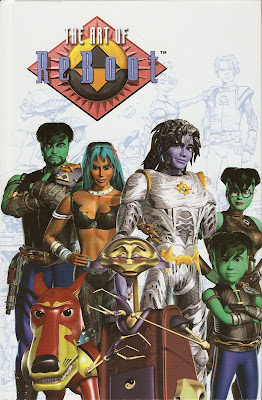
Book Review: The Art Of ReBoot

Considering that every major animated film coming out of Hollywood these days is CG, it's amazing to think that there was a time when CG wasn't as prevalent as it is now. There was a time when CG was considered unproven and risky. There was a time when the prospect of making even a CG movie seemed almost preposterous. This makes it all the more incredible that something like the Saturday morning animated series ReBoot actually happened.

Premiering in 1994, before the world would be wowed at Pixar's Toy Story, ReBoot was the first full-length, completely computer animated television series. Produced by Canada's Mainframe Entertainment, ReBoot imagined the world inside a computer, a world where sprites, viruses, and binomes roamed. This action/adventure series, peppered with a unique sense of humor and lots of geeky references, garnered a large cult following.

Now, DMF Comics has released The Art Of ReBoot, a fascinating and eye-opening look into the creation of this groundbreaking TV series. Featuring tons of never-before-seen artwork, this book not only confirms the artistry of this series, it's a love letter to the show's fans.


The Art Of ReBoot is not a hefty coffee table book. It's a slim hardcover with a glossy exterior and full-color pages. The book features a wide variety of artwork from the TV series including production and pre-production art, screenshots from the series, and other artwork including a look at the toys from the show. It also acts as sort of a guide to the series. In the sections dealing with the various characters, short (and sometimes spoileriffic) character bios are included. People who worked on the show, including co-creator Gavin Blair, tell about their experiences in short blurbs throughout the book.

Given that ReBoot was a CG show, you might think that the bulk of the artwork in the book would be CG. That's not the case. Everything CG has to start off as 2D designs first, and this wonderful artwork is the revelation of the book. The drawings, many of them drawn by production/character designer Brendan McCarthy, are great. Seeing these drawings makes you realize the incredible amount of artistry involved in making animation of any kind. It's also really cool to see how well these drawings translated to CG animation. In some cases, such as the villain Megabyte, the designs are so good that little is changed. There is so much life in these drawings that you realize that ReBoot would've probably made a cool 2D animated series too.

Apart from all the production artwork, one of the most interesting parts of this book is the section entitled “ReBoot Re-Imagined.” This section features comic book artists' take on the ReBoot characters. There is some very nice artwork found in this section and it makes you hopeful that the ReBoot story (which ended on a cliffhanger in Season 4) could continue in the comic book format. Other shows such as Buffy The Vampire Slayer and Gargoyles have continued in comic book format and I'd love to see ReBoot added to that list.

The Art Of ReBoot is a nice artbook that is a must-purchase for fans. It gives you a fresh look at this animated series and all the hard work that went into it. With the show being off American television for years and only sparsely available on DVD, this book is one of the few ways for newcomers to learn about the show. ReBoot proved that the type of animation used didn't matter as long as the story and talent was there. That's a lesson that Hollywood would do good to learn.

The Art Of ReBoot can be ordered direct from the publisher at ReBootArt.com.

Wednesday, November 15, 2006

Book Review: Lions and Tigers and Crocs, Oh My!: A Pearls Before Swine Treasury

Stephan Pastis's comic strip Pearls Before Swine is not like other strips. The main characters have generic names. Strips deal with topics such as death, sex, and relationships. The cartoonist appears as a character in the strip from time to time and the strip is not afraid to viciously make fun of other strips and other cartoonists. This dark and subversive (but hilarious) comic strip isn't for everyone but fans and newcomers alike will find a lot to enjoy in Lion and Tigers and Crocs, Oh My!, the second Pearls Before Swine treasury.

For those who have never encountered Pearls, the strip revolves around a group of anthropomorphic animals. The main characters are Rat and Pig. Rat and Pig are friends and roommates who are complete opposites. Rat may very well be the most self-centered character in all of comics. He engages in various schemes to make money, cares for no one but himself, and has a pretty pessimistic view of life. Pig is a kind soul who is eternally optimistic. However, he is also quite dumb and can misunderstand even the simplest of things.

Pig and Rat are friends with Goat and Zebra. Goat is the smartest character in the strip, an intellectual who tries to clarify things for the duo. Zebra is almost as optimistic as Pig but not nearly as dumb. He tries in vain to keep predators (mainly lions and crocodiles) from killing his kind through various diplomatic means.

The storylines that appear in this treasury give you an idea of this strip's unusual sense of humor. One set of strips has Rat opening a pizza parlor where women can turn in their husbands for a free pizza. Another chronicles Pig's ill-fated romance with Ms. Bootyworth, a bottle of pancake syrup. Rat attempts a takeover of the strip and makes Pastis give into his demands by spouting Cathy and Garfield punchlines. Pig visits a slaughterhouse and thinks it's a pig singles party. There are encounters with an agoraphobic turtle, a needy porcupine, and the introduction of the crocodile frat brothers of Zeeba Zeeba Eata who become Zebra's next door neighbors.

Lions and Tigers and Crocs, Oh My!, like its predecessor Sgt. Piggy's Lonely Hearts Club Comic, features annotations on some strips by creator Stephan Pastis. These comments make this treasury stand out from others of its kind. The comments feature anecdotes about the inspiration for certain strips (one strip was inspired by a fight he and his wife had), reader reaction to controversial strips, hidden references in the strip, and even things he doesn't like about certain strips (he called one of the slaughterhouse strips “overly dark”). In reading the annotations, you get the sense that Pastis has a deep respect for the art of cartooning and the comics page. You can tell that he loves what he does and has a blast doing it. This treasury also contains a section of unedited and unpublished strips that feature annotations explaining why they never made it to the newspapers.

All in all, this treasury is the perfect addition to any comic strip fan's collection. It's a good introduction to the world of Pearls Before Swine. It's also a good buy since it costs less than the total combined price of Nighthogs and The Ratvolution Will Not Be Televised, the books where the strips in Lions and Tigers and Crocs, Oh My! were first published. If your town's newspaper is not one of the more than 350 papers that Pearls Before Swine appears in, this is the way to read one of the best strips in the funny pages today.

Saturday, November 12, 2005

Book Review: Make It Happen: The Hip Hop Generation Guide To Success

Kevin Liles, the executive vice president of Warner Music Group and former president of Def Jam, offers his tips on becoming successful in Make It Happen: The Hip-Hop Generation Guide To Success. Using a combination of quotes, memoirs, inspirational stories, and traditional self-help teachings, Liles puts his spin on the motivational book and makes it relevant to readers who would normally think that books like these are corny.

Make It Happen, written by Liles and Samantha Marshall of Crain's New York Business, is organized into ten rules. These rules are primarily variations on traditional principles. For example, the second rule, "Do You," is a combination of the principles of standing out and being yourself. Liles tells the reader to "Find a style that expresses your personality" but also to make sure that the style you do put out is "not just some cheap counterfeit of someone else's brand." Rule seven, "Get Connected," simply means that you should network and be nice without becoming a pushover. Rule five is to "Play Your Position," which in other words means to always work hard no matter what you're doing.

What makes these rules stand out from other books is the fresh way that Liles explains them. His writing is conversational and he does not come off as being preachy. He uses lots of anecdotes from his life and the lives of others to make these rules relevant to the hip-hop audience. In the "Do You" chapter, Liles tells of how he ended up working for Def Jam. In the "Create A Blueprint" chapter, he mentions his days as part of the rap group Numarx. In one instance, his preparation and attention to detail helped catch the group's manager in the act of withholding money from the group. He also mentions how Ludacris started off, how Shyne took responsibility for his actions, and how Jay-Z calculates every move he makes in order to explain his rules.

The philosophies behind Make It Happen value hard work, perseverance, intelligence, passion, and humility. Higher education isn't seen as the only road to success. Liles himself did not finish college and while he does not discourage higher education (and emphasizes that you must at least finish high school), he feels that it's pointless to "study for studying's sake."

Overall, I feel that Make It Happen offers a lot of advice without hypocrisy or arrogance. The type of rules provided here give you an idea why hip-hop has been able to grow from a "fad" into an industry. However, even if you are not a fan of hip-hop, Make It Happen can inspire you and give you useful tips for your own quest for success.